


From match day to multi-use | Directivity matters | Prediction and processing | Custom solutions | Safety first | It’s all about collaboration | Future-ready
The last few years have witnessed a significant shift in how stadiums are designed, operated and used. They are no longer defined by a single purpose. While sport remains at their core, modern venues have evolved into year-round destinations, hosting everything from league fixtures and international tournaments to concerts, festivals, corporate events and community gatherings.
With this increased scope come increased expectations and added complexity. Audio systems are expected to support a wide range of requirements, often within the same venue and sometimes within the same day. Beyond its functional role, audio helps shape the atmosphere of an event. The most memorable moments in stadiums are often collective experiences, shared by tens of thousands of people at once. This is when fans feel the difference in a way that can’t be replicated anywhere but alongside thousands of equally impassioned people.
Short throwback to a different time - shoutout to Stefan Goertz (Director of Global Education & Application Support at d&b) for this little excursion to the 1990’s.
There was a time when sports venues were then equipped with public address systems primarily used for match day announcements and compliance with life safety legislation. This was an era when requirements and sound system budgets were not aligned with today’s objective for full fan engagement and considered outside the remit of high-performance loudspeaker system manufacturers.
Early stadium projects at d&b relied on a limited portfolio of equipment. Around 25 years ago, only a few loudspeakers were suitable for such environments. Larger, point-source loudspeaker systems, such as our heritage d&b C7, with its coaxial design and controlled dispersion, proved to be quite a good solution in that era. Those early projects helped us shape a principle that still counts today: life safety compliance is the starting point, not the end goal. Meeting SPL and intelligibility requirements is fundamental, but for many years legislative requirements for the delivery of critical announcements effectively became the performance specification.
Changing this perception required persistence, technical conviction and a different approach to system design. The challenge was no longer simply to meet minimum requirements, but to create systems capable of delivering both clear communication and great audio experiences across a wide range of use cases.
Fast forward to today, where stadia and arenas are expected to support an increasingly diverse range of events. A sound system that delivers clear announcements to tens of thousands of fans must also be capable of creating a high-quality listening experience.
Then there are increasingly complex regulatory frameworks, particularly in the context of life safety and system reliability. Beyond national standards, governing bodies such as FIFA, UEFA and the NFL have their own requirements for speech intelligibility, sound pressure levels, bandwidth, coverage consistency and frequency response – increasingly with a nod to fan expectations.
As you can imagine, when presented with large, complex and reflective structures, open or semi-covered bowls, exposure to changing weather conditions and dynamic crowd noise, meeting these performance requirements is anything but straightforward.
And compliance isn’t everything.

From match day to multi-use
It’s incredible what schedules modern stadiums run, with many venues operating packed event calendars throughout the year. Let’s take Wembley Stadium, home to a diverse range of events and attracting millions of visitors annually: football today, followed by a concert, then boxing before hosting a global tour.
This leads to the question: how can a permanently installed sound system support such diverse demands?
Historically, systems optimized for public announcements were often treated separately from those designed to deliver entertainment experiences. Today, that distinction is becoming increasingly impractical. What is needed is an integrated approach that sees versatility as a core requirement. Permanently installed sound systems must provide functional flexibility, accommodate operational complexity and deliver reliable, predictable performance across a wide range of events.

Directivity matters
You knew this was going to happen – it’s time for our mantra.
As stadiums expand their role, particularly in urban areas, another challenge comes into focus: controlled sound transmission. Sound pressure levels remain important, but only when combined with precise control of how and where the audio is delivered.
Technologies such as the d&b SL and CL-Series have demonstrated how broadband directivity control and low-frequency cardioid behavior can significantly improve the audio performance in venues of all sizes, allowing sound to be delivered precisely where it’s needed while minimizing unwanted energy into roof structures, spill onto the pitch or beyond the stadium perimeter.
Noise regulations are on the rise and many venues are located close to residential areas. At the same time, stadiums are designed to preserve the natural energy and shared emotion of the crowd, relying on sound systems to deliver clarity while remaining capable of rising above high ambient levels when it matters most.
While large-scale concert production deployments are often built upon KSL and GSL, we’re also seeing growing adoption of XSL, CCL and A-Series systems in permanent stadium installations. Their combination of output, efficiency and flexibility makes them particularly well suited to projects where weight limits, infrastructure constraints, sightlines and energy consumption all play an important role.
This approach helps democratize the listening experience. It extends the same principles of clarity and control across the venue, helping deliver a consistent experience from the main bowl and field of play to VIP areas and under-balcony spaces.
How do we do it?

Prediction and processing
First things first. Long before installation begins, there’s precise prediction. Detailed acoustic simulation is used to verify the performance of a system against defined targets for SPL and intelligibility. This provides a reliable basis for both system design and compliance measurements on-site.
This level of accuracy depends on the quality and fidelity of the underlying data and the depth of investigation behind it. In complex stadium environments, reliable modelling is not the result of standard assumptions, but of detailed, project-specific engineering.
At d&b, this is supported by highly accurate and trustful electroacoustic data, rooted in consistent laboratory measurement practices and a deep understanding of modelling the loudspeaker and system controller behavior as a unique device. Combined with application-driven system design expertise, this allows each project to be evaluated and refined against clearly defined performance targets. The result is a modelling approach that translates reliably into real-world outcomes and gives stakeholders confidence that what is predicted on paper will hold true in practice. For us, d&b ArrayProcessing comes into play once the array type, placement and geometry have been optimized.
By enabling highly accurate optimization of level distribution across large audience areas, systems can be refined beyond what can be achieved through mechanical adjustments alone, allowing performance to be tailored precisely to each venue while maintaining the established array shape.
It also helps to scale system configurations. You would be surprised how much more we can do with less. It allows us to plan extremely efficiently while the results often exceed expectations.
The outcome is a system that is not only precise and predictable, but also flexible, rider-friendly and capable of evolving with the venue over time in the most efficient and sustainable way.

Custom solutions
If you’ve visited a few, you’ll know: no two stadiums are identical. Architectural constraints, structural limitations, heritage considerations and operational requirements often create challenges that we can’t solve through standard products alone. We need a bit more.
d&b Custom Solutions has become an increasingly important part of many stadium and arena projects. It’s a dedicated offering to help address unique mechanical, environmental and operational requirements while maintaining the same performance objectives.
They can range from weather-resistant versions for demanding environments to bespoke mounting and rigging solutions, or loudspeaker modifications designed to accommodate specific architectural and aesthetic requirements.

Safety first
While concerts and live performances play an increasingly important role in the yearly calendar, safety remains a key requirement.
Clear communication in both routine but also emergency situations is essential. This places significant demands on system design, requiring consideration of redundancy, zoning, fallback scenarios and message prioritization from the earliest stages of a project.
Equally important is the resilience of the electronics that support the system. Stadium environments place demanding requirements on amplification platforms, which must continue to perform reliably during temporary power fluctuations and other forms of electrical stress. This is one reason why amplifier design plays such an important role in modern stadium systems. Beyond delivering power and processing, amplification platforms must provide the stability and resilience needed to support consistent performance in all conditions.
Product standards such as EN54 and EN50849 provide important frameworks, but successful implementation ultimately depends on how the entire system is designed, integrated and verified.
For that reason, reliability is not viewed as a feature of individual components, but as a characteristic of the complete audio ecosystem.

It’s all about collaboration
Given all this complexity, audio can’t be treated as an isolated discipline.
Successful stadium projects rely on close collaboration, both internally and externally. For us, that means coordinated work across our global Education & Application Support (EAS) teams and close cooperation with colleagues across EMEA, the Americas, APAC and GCN. Each and every one of us contributing specific expertise to different stages of a project.
Externally, we work closely with architects, consultants, d&b's global network of installation and integration partners, venue operators and AV teams, supporting them all the way to the finish line – from the earliest stages of acoustic modelling through to installation and final commissioning.

Future-ready
Stadiums will continue to evolve, and audience expectations will continue to rise.
The most successful venues will not be those that are simply the loudest. They will be the ones that achieve clarity, consistency and control, delivering the right sound, in the right place, at the right time, for a long time.
In a world of growing expectations and increasing complexity, versatility is no longer optional; it’s becoming one of the defining characteristics of a truly future-ready stadium.
By Dominika Obwarzanek, Senior Applications Engineer, d&b audiotechnik
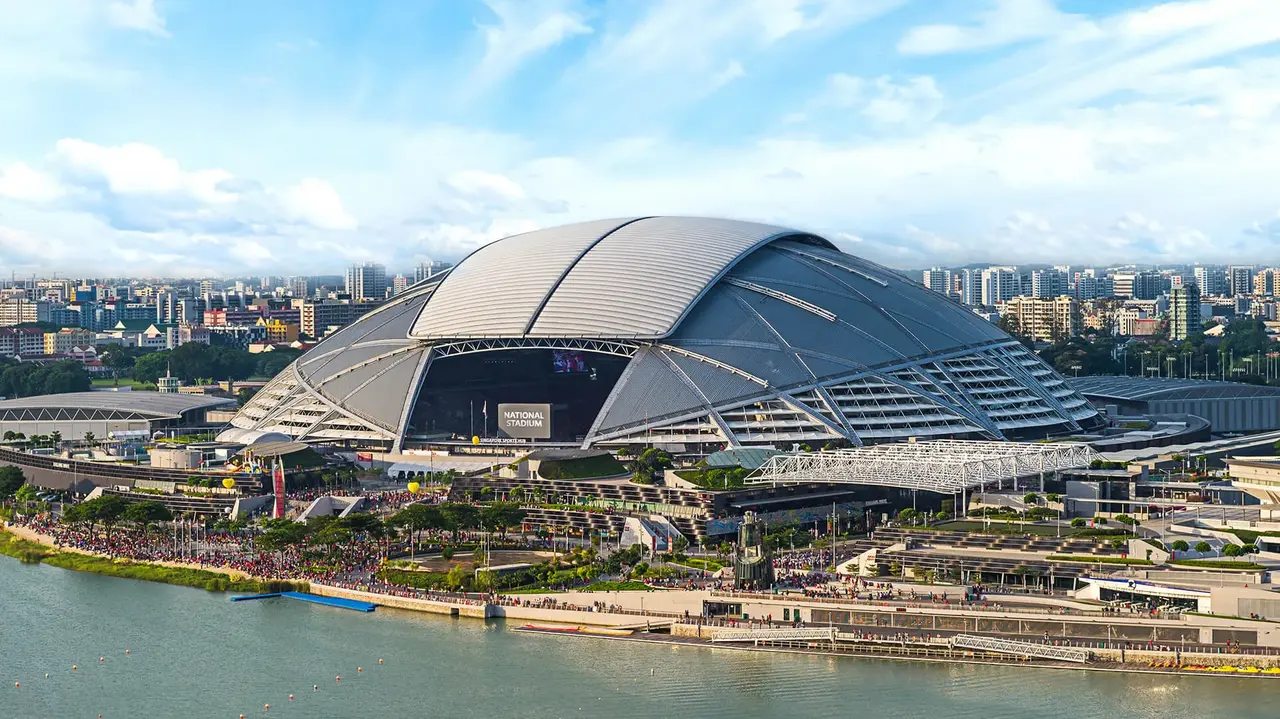
Over the years, we’ve supported stadiums of all sizes, including renowned venues such as SL Benfica’s Estádio da Luz, Seattle’s Lumen Field and National Stadium Singapore. Curious to see these principles in action? Then please explore our stadium projects and case studies:


