Steve Reich at 90 takes a spatial dimension with d&b Soundscape
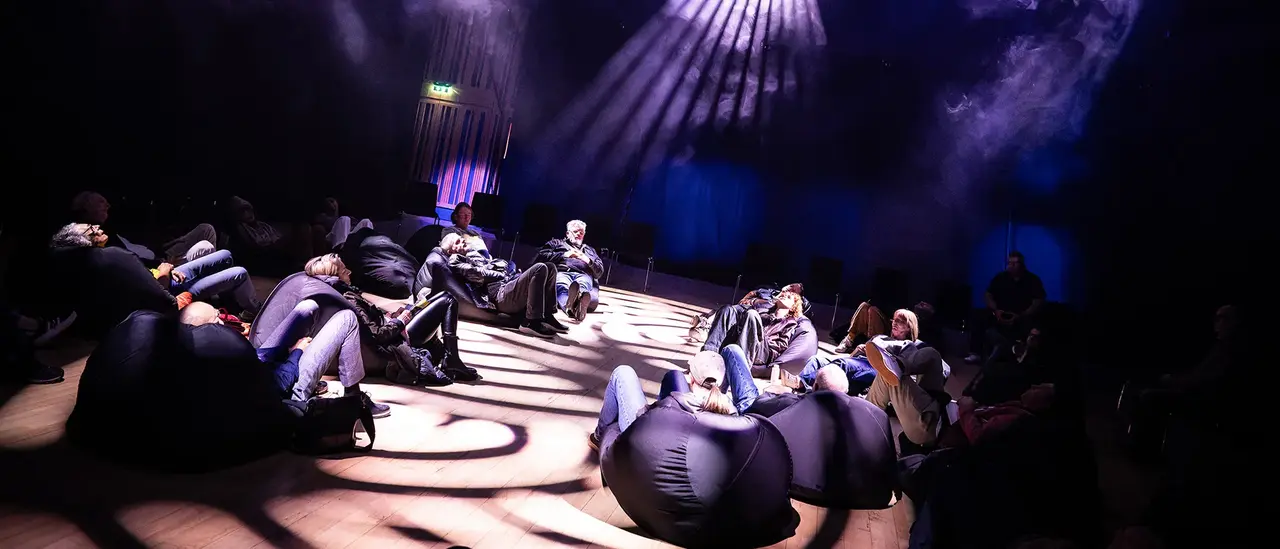
Few musical compositions lend themselves to spatial audio playback as much as the hypnotic, harmonic, phase-shifting works of Pulitzer Prize-winning composer Steve Reich. As part of the recent Steve Reich at 90 festival to mark the composer’s 90th birthday, Phase | Pattern | Pulse made that a reality – using the power of d&b Soundscape to present three programmes of Reich’s landmark works as a 360˚ immersive listening experience.
Staged at The Glasshouse in Gateshead, Phase | Pattern | Pulse was created by spatial-audio specialists Loss><Gain, in collaboration with Sound Intermedia, using recordings of Reich’s work performed by Colin Currie Group. Sound designer, David Sheppard used the d&b Soundscape system to provide immersive sound power for this remarkable installation.
Sound Design for Phase | Pattern | Pulse

David Sheppard (one-half of Loss><Gain alongside John Best, long-term manager of Sigur Rós) served as sound coordinator for the entire festival, as well as sound designer for Phase | Pattern | Pulse. For him, having worked with Reich over many years, this was clearly a labour of love.
“It was about going inside the pieces and thinking about that experience,” Sheppard explains. “This music is about the relationships between multiple rhythms, harmonics and harmonies that build and oscillate in the space. We asked, ‘how can we experience this music in a different kind of way? In a way not possible in any other environment?’”
Reich’s music – with its rich, layered textures, precise percussion, gradual phase shifts and repetition – rewards close listening. Sheppard’s approach, therefore, was to place the listeners “right in the middle of the instruments”, bringing them closer to the experience of the performers, but also – thanks to Soundscape – keeping detailed control. “Every element of the compositions could be presented together in the way Steve intends for us to hear it, but we have the added benefit that we can control every element in the space,” Sheppard explains. “That’s a unique thing that you just don’t get in a concert hall.”
Enhancing the Narrative
For Sheppard, spatial listening via d&b Soundscape magnifies the power of the narrative. “It gives the audience a connection with the music that they can’t get in any other system. Not having the musicians in the room could be seen as a negative, but it means you’re just dealing with what you’re hearing. It gives you permission to do nothing else, just listen.
“Your imagination starts to build your own story from the music,” he explains. The special thing about Soundscape and immersive sound generally is that it gives objects depth, so you truly believe the instruments are actually in the room with you. It becomes a musical instrument in a way that other sound systems just aren’t.”
Playback Finesse

Sheppard’s choice of loudspeaker to faithfully relay the music was d&b’s new U3 point source, offering full bandwidth output with exceptional directivity control and electroacoustic efficiency. “When I first heard a demo of the U3, I was immediately struck by the stability and clarity of sound image,” he recalls. “It somehow seemed to add depth from a single speaker just by spreading so evenly. The tonal depth and image clarity across a whole space made it the perfect choice for Phase | Pattern | Pulse.”
He adds, “Multiple U3s combined, and utilising sound objects in Soundscape, that wonderful moment occurred where loudspeakers disappear and you are simply listening to music.”
Magical Moments
The installation presents three programmes – Drumming, Sextets and Music for 18 Musicians. Each, says Sheppard, contain moments of personal highlight. One is in Drumming, when the ‘sonorous’ tone of marimba mallets is gradually replaced by the ‘metallic, crystal’ sounds of glockenspiels. As the marimbas decline, Sheppard brings their sound image slowly to the centre of the room: then, as the glockenspiels take over and grow in intensity, their sound expands outwards. “The resonances combine into this enormously beautiful cloud of sound,” Sheppard describes, “and as the glockenspiels move outwards, this kind of crystal ‘halo’ forms. It’s such a magical moment.”
Colin Currie concurs: “This installation is a completely different way to experience Steve’s music. It unveils it in a new and deeply moving way. And it is not just that the music exists in a very high quality audio experience, it surrounds the listener in the most delightful and uplifting way.”