WOMAD Festival back in control with d&b audiotechnik
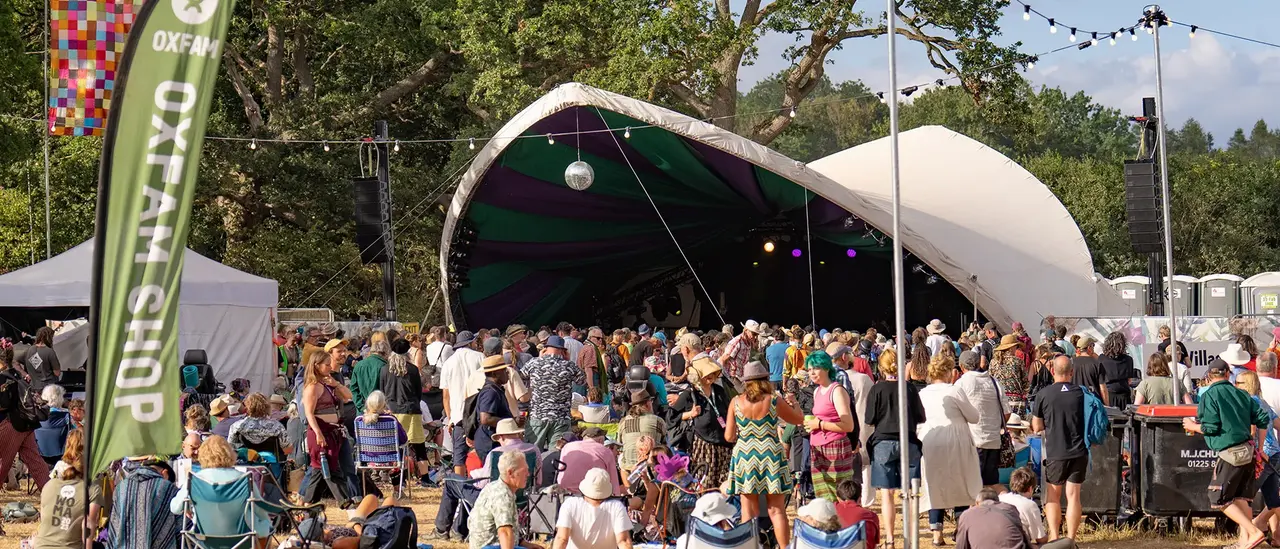
After taking a break in 2025, WOMAD Festival returned this summer at a new site – Neston Park in Wiltshire. This year, for the first time, six of the event’s main stages were equipped with d&b audiotechnik sound systems, led by main PA supplier, Amber Audio.
WOMAD’s Return
WOMAD (World of Music, Arts and Dance) celebrates music, arts and dance from across the globe. Founded in 1980 by Peter Gabriel, it has become a feature of the UK – and the wider world’s – festival circuit.
After re-evaluating the event during a ‘fallow’ 2025, WOMAD returned this year with a more compact footprint at a new location. Inevitably, the move brought with it new uncertainties about environmental noise. Although Neston Park is a ‘rural’ site, there are villages and isolated residences in the surrounding area – and one complaint is still one too many. It was clear that sound control would need to re-appraised across the board.
Another difference this year was that WOMAD’s technical production provider Judgeday, led by Chris Hayter, selected d&b partner Amber Audio to design and supply the three main stages: the Open Air/World Stage, Big Top and Village Stage and also the main workshop stage, Rhythm & Rhyme. In addition, d&b Solutions supplied the Sunflower Stage and Taste the World. This meant that, for the first time, all of WOMAD’s six largest stages used d&b audiotechnik systems.
Amber Audio with d&b
“We’re a solely d&b rental house,” explains Amber Audio co-director Paul ‘Bully’ Bullimore. “We don’t stock any other manufacturers’ systems.”
With site plans from Judgeday, Bully set about designing the required systems in d&b ArrayCalc. When the World Stage plan expanded from a smaller concept to 10,000 capacity he opted to use a KSL-based system consisting of left and right 12-deep hangs, with an SL-SUB array, plus Y7P and V7P for delays and fills. “The KSL is such an incredible sounding system,” says Bully, “so controlled, so clear.”
The system for the Village Stage featured CCL for the mains, using hangs of CCL8 and CCL12, supplemented with 12 CCL-SUBs and Y7P for front-fills. It was Amber Audio’s first taste of CCL in action, but they had confidence enough in d&b to include it. “We were very keen to hear the CCL properly, and it didn’t disappoint,” says Bully.

NoizCalc Puts Minds at Rest
The cardioid nature of the KSL and CCL systems helps to control the sound energy in such situations – a fact which proves valuable for both the audience on site and those living in the surrounding area.
To model offsite levels in advance of production, Bully used d&b’s NoizCalc. “It’s such a great tool,” he says. “It always gives us a real advantage because you can put everyone’s minds at rest about potential problems – especially when there are question marks over a new site, as we have here.”
He says, “In fact, NoizCalc proved decisive in determining the main stage’s finishing time. They had hoped to run to midnight, but our calculations showed that after 23:00, when controls become stricter, we would have needed front-of-house levels around 90dBA to meet offsite limits, which would be unacceptable for headline acts. So that set an 11pm main-stage curfew. It’s always better to know.”
A Sustainable Approach
With sustainable production a priority for Amber Audio, d&b and Judgeday equally, another notable first for this year was that the World Stage was run entirely on battery power. After a single 3MWh battery from Grid Faeries powered the Charlie Gillet Stage in 2024, this year two were used to power the main stage.
“Exploring ways of doing things sustainably is very important to us all,” says Bully, “but also, it really does seem that having that clean, constant power source, as opposed to a generator which has to cycle up and down, actually makes a difference in the delivery of sound. Yes, we were using KSL, so it would be excellent anyway, but when your aim is to get things to sound better, even those tiny margins can make a difference.”
A Dream Come True
Bully describes the overall sonic result as exceptionally successful. “The main stage sounded fantastic,” he says, “as did the Big Top, and the Village, the Workshops and all of it. Everyone really noticed the quality of the sound – and the consistency of sound between the stages.”
“I was so pleased from a professional point of view. And that’s down to the kit as much as the engineers and the artists. I’ve always thought of d&b as one of the very best manufacturers at translating an artist’s sound as cleanly as possible.”
He concludes, “For us, WOMAD was an absolute dream come true. Front-of-house engineers set very high standards audio wise – and I include myself among them – but I found it very difficult to find anything to be unhappy about. That was great for a first year. Also, the WOMAD hardcore fans were feeding back that it sounded great everywhere – which is all we can ask for, really!”
It’s feedback Chris Hayter, technical production manager for WOMAD agrees with: “Amber have consistently delivered an outstanding service, combining technical expertise with the flexibility to meet the unique and often bespoke requirements of our artists. Their professionalism, reliability and commitment to quality have been essential in helping us maintain the exceptionally high standards we expect from our technical production.”