Royal Albert Hall continues trust in d&b audiotechnik with the latest cardioid standard
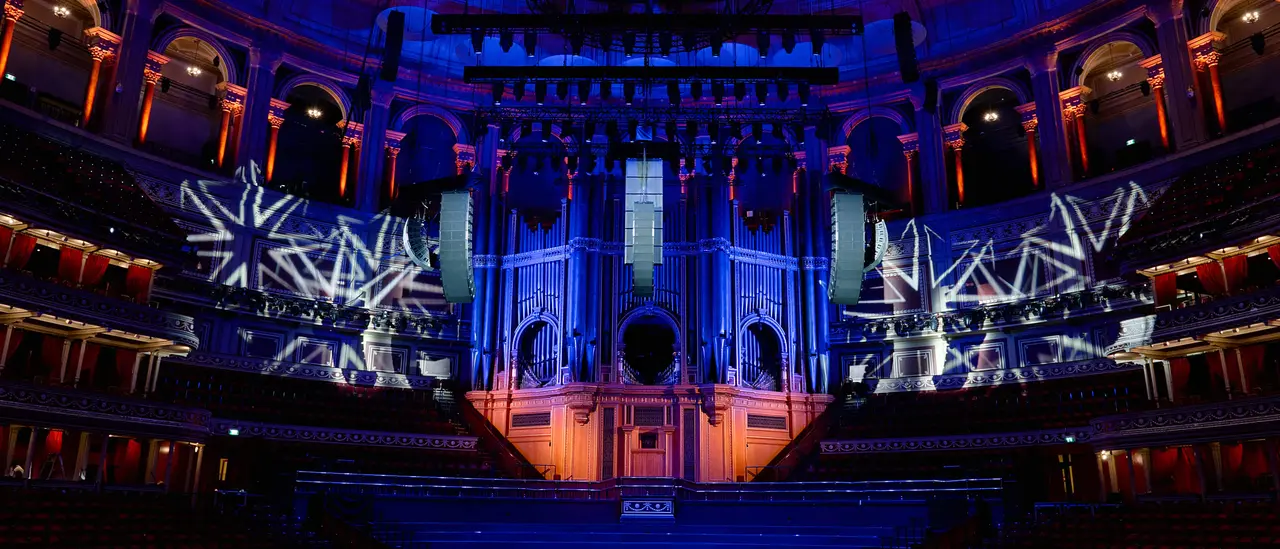
London’s Royal Albert Hall, a venue of rare global prestige, has continued its commitment to d&b audiotechnik by upgrading its house sound system with a new cardioid solution based around the company’s KSL, XSL and CCL elements. This latest system, with its extraordinary directivity control, delivers the highest standard of listening experience yet enjoyed at this historic, landmark venue, ensuring peak performance for generations to come . . .
Conquering the Room
Opened in 1871, long before the dawn of electroacoustics, the Royal Albert Hall (RAH)’s architectural grandeur has gone hand-in-hand with its acoustic challenges. This new installation from d&b audiotechnik introduces the company’s latest generation of cardioid technology, taking the hall’s acoustic performance onto yet another level.
That was to change in 2018, when the 5,270-capacity venue underwent a major sound upgrade. A distributed system of over 400 d&b loudspeakers, painstakingly designed by d&b with input from acoustic consultancy Sandy Brown, expanded the sound quality and service on offer to visiting productions, with take-up of the house system increasing to “nearly every show” says the hall’s Audio Operations Manager, Richard Sally-Lower.
The 2018 upgrade was hugely successful. It addressed the RAH’s acoustic challenges as never before, significantly improving the hall’s operational landscape. Before, it had no full-time sound personnel, but since the house sound team has grown to eight full-time staff, with access to around 30 freelance crew as needed.

The Cardioid Revolution
In the same period, d&b’s technology has continued to advance. Its systems’ cardioid performance, embodied by SL-Series and more recently CCL, can now offer a vastly more controlled sound environment – of benefit to audiences, artists and engineers alike.
“The distributed system of 2018 was remarkable – way better than anything we’d had before,” comments Richard Sally-Lower. “The new system improves even further on that. We’ve not redesigned anything, it’s mostly like-for-like, but with newer technology. Yes, there are some extra elements – we’ve gone a little bit bigger to cater for the larger shows – but the key improvement is the cardioid aspect.”
The new system is the result of an accumulation of innovations – with cardioid performance the icing on the auditory cake. Steve Jones, Team Leader of d&b’s Education and Application Support EMEA, who led the designs of both the 2018 and 2026 upgrades, summarises, “With the distributed system design, the impact of ArrayProcessing providing that evenness of coverage everywhere, and now with the added cardioid advantage, pretty much all of the energy in that room is pointing at the audience members, and being absorbed by them. There is very little sound going anywhere else.”
KSL, XSL and CCL
Following a market comparison looking at alternative manufacturers’ systems, the chosen d&b concept – as required by the brief for this protected building – retained most of the 2018 positions and infrastructure, adding new equipment only where it improved coverage and capability. The system sees KSL, XSL and CCL arrays, with their inherent cardioid characteristics, improve controlled directivity and clarity across the reverberant hall.
In total, the new installation draws on more than 140 new loudspeaker elements. The main left and right hangs, twelve deep, are KSL, while XSL arrays are used for outfills and choir positions, as well as for two entirely new central hangs intended to enhance Soundscape use. To increase capability, additional low end is provided via a reconfigured central hang of SL-SUBs and new XSL-SUBs on the ground.
CCL arrays serve as circle delays, while 42S speakers have been added as discreet front-fills, particularly for orchestral shows, replacing the 16C column speakers employed previously. Meanwhile, the boxes and gallery speakers remained largely unchanged – with 4S speakers adding delays and a degree of ‘depth’ to the somewhat isolated boxes. The left, centre, right system and Soundscape hangs are driven via d&b 40D installation amplifiers. D90 amps power the flown subwoofers and the remainder of the system runs on the existing infrastructure of D80, 30D, 10D and 5D amps.
Likening the improvement to the time he first heard d&b ArrayProcessing in action, Jones says, “It’s one of those moments where, once you hear it, you never want to go back to the old way.”

The Expansion of d&b Soundscape
The 2018 upgrade included d&b Soundscape capability to allow an additional creative offering for incoming productions if required. Now, that capability has been enhanced. Whereas previously, its use had required additional loudspeaker hire, cabling, amplifiers and labour, this new upgrade has added permanent, flown XSL hangs dedicated to Soundscape, to avoid the setup burden. It also expanded from two DS100 processors to three of the latest DS110 units (including one for redundancy), increasing the available output capacity, and therefore system resolution.
Sally-Lower explains, “We’re finding that touring productions are increasingly asking for Soundscape, but we also use it for our own productions, for example our seasonal run of shows in December. We also see value in using it proactively to enhance the service we offer clients – even when it’s not a specific client request.”
A Big Step Forward
The new system marks a milestone for the sound of this challenging room. Importantly, as well as being effective right now, it lays the ground for the future progression – maximising both the hall’s reputation and its investment.
Jones says, “With an iconic venue like the Albert Hall, where there’s history in the brick, you can’t just keep moving the PA every five years. You’ve got to respect the building and get the design right. Here, we’ve put in not just a PA, but infrastructure that will last through generations of PA. In 2026, we’re using pretty much every point installed in 2018, without changing that infrastructure. That’s a testament to the right questions being asked during the first project.”
Sally-Lower concludes, “This system is a massive benefit for such a reverberant space, and another really important step forward in improving the sound of the hall. And that improvement is across the whole system – not just a small part of it.”