


d&b audiotechnik’s Soundscape, Create.Control and U-Series deliver fresh new sound for RENT’s West End return
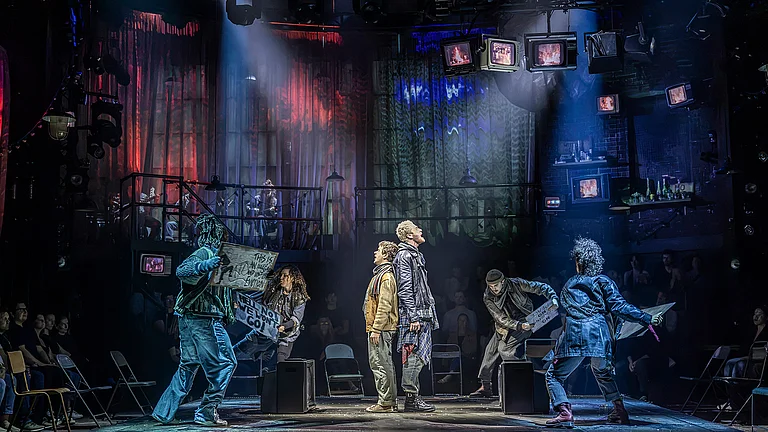
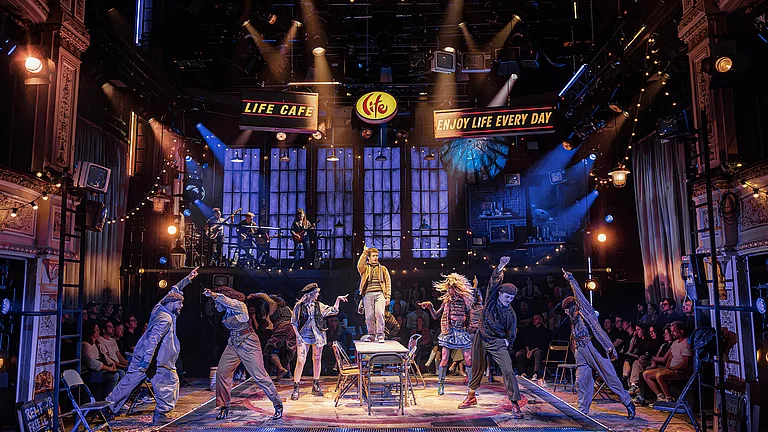
BACKNANG/Germany, 23 November 2026 – For the return of adored musical RENT, at the Tom Stoppard Theatre in London’s West End, sound designer Paul Gatehouse draws on his extensive experience with d&b Soundscape, along with the newest innovations in d&b’s toolkit, to help deliver a bold and powerful revival experience.
Sound for a RENT revival
Few musicals have impacted the theatre world like RENT, the Pulitzer Prize and Tony Award-winning creation of Jonathan Larson – who tragically died, aged just 35, the day before the show’s first preview in 1996. Now in its 30th anniversary year, this beloved show has returned to the West End with a production directed by Luke Sheppard (Paddington The Musical), starring Gaten Matarazzo (Stranger Things) and with a fresh new sound design by Paul Gatehouse, incorporating object-based audio with d&b Soundscape.
Gatehouse has long been in the vanguard of this technology. He explains, “I jumped on it when it was launched in 2018 .I was interested in how much better it is at providing the same sonic experience for everyone. It’s so democratising.”
On successive productions Gatehouse has refined his d&b Soundscape workflow to the point where he is confident to tour it (as with the successful UK & Ireland tour of Mary Poppins), to take it to Broadway (with SIX: The Musical) and to employ it here, amid the smaller-venue challenges of the 650-seat Tom Stoppard Theatre.
“London has a number of smaller playhouses, but if you can get things to fit in a way that makes sense, Soundscape really can work in this kind of environment,” he says. “The perception is that object-based audio is best suited to a large format, but it’s very scalable and can be achieved in a number of ways.”
The Soundscape advantage
In fact, aside from the superior listening experience offered by d&b Soundscape, there can be physical benefits for smaller theatres, he believes. “Because there’s limited space on the sides of the proscenium, using short line arrays or point source speakers in those positions can result in very uneven level and tonality front to back. Having everything elevated, including the sub array, puts you in a much better position to achieve even coverage – especially for a show like RENT, which is quite high-powered.”
Gatehouse positioned five low-profile d&b AL90 augmented arrays across the advance truss, along with four XSL-SUBs. “A-Series is useful because it provides a lot of vertical coverage from quite a short line length,” he explains. “With standard line array units, you’d need quite a deep line. That’s fine if you’ve got the space, but in a compact, multi-level auditorium, sightlines sometimes make that difficult.”

New loudspeaker solutions
This production is also Gatehouse’s first deployment of d&b’s new U-Series. He uses a pair of U7s on the proscenium as a ‘low front anchor’ for listeners farther back in the stalls, while Soundscape maintains lateral movement and source positioning. More U7s, along with U3 and U5 loudspeakers, are used in various delay and fill roles, essential in this intimate, balconied space. “The great thing about the U-Series is that the tonality of the whole family is very similar, so you can mix and match,” he notes.
Gatehouse praises the U-Series’ strong low-mid presence that belies their size. “The voicing is just incredible. Very smooth, very open. The low-mid voicing, even in such a small format speaker, still sounds big.”
The design also utilises d&b’s ultra-compact 42S loudspeakers. “For something that small they’re pretty incredible for the sound that you get out of them,” he says. “They’ll certainly be used for front-fills and for putting inside scenic elements. They’re great for surrounds too, because they’re light, but punchy and powerful. And again, tonally they’re a great match to the U-Series.”
Zoning challenges
“On stage, we’ve got three seating banks, with an array of seven U7s covering those banks, and that’s all part of the same Soundscape system,” Gatehouse explains. “Our actors are still vocally tracked in the stage system using En-Scene, but each seating bank has its own matrixed stereo music system. With the on-stage audience facing so many different directions, and with predominantly stereo sources, object-based music wouldn’t work there. In the main auditorium, though, the band runs as En-Scene objects as well as the vocals.”
Another key aim for on-stage sound was to maintain separation between the cast monitoring and the audience system. “To do that we had four E4 speakers within the stage platform,” Gatehouse explains, “and then a single U7 overhead, and that keeps everything contained to that area.”
d&b’s soft skills
In achieving this finely-balanced environment with confidence, Gatehouse is well aware of the importance of d&b ArrayCalc software to the system’s operation, and depends on its ability to accurately predict real-world performance. His workflow uses a tripod-mounted laser in a gimbal to measure the precise position of each speaker: the XYZ coordinates are then imported into ArrayCalc.
Another key software element is Create.Control, the user interface for d&b Soundscape. “We now use the new Create.Control software as a UI at the production desk to control the DS100, separate from R1,” he explains. “It’s client-based, so multiple operators can be on it simultaneously, and it’s a very responsive piece of software. The GUI is great, very easy to understand and very fast metering. It gives a good ‘holistic’ snapshot of the object-based part of your system.”
Streamlined and efficient
Gatehouse has long been at the forefront of understanding what d&b Soundscape can offer – his experience and feedback have helped to refine it into the increasingly streamlined and efficient tool that it is today. He concludes, “Now, for us, it feels very quick and easy. In my work I try to give myself uncomplicated options, so I’ve got a lot of creative scope that’s very quickly accessible.”


